The importance of role awareness in dancing and collaboration
- February 3, 2022
- min reading time
- Robin Schram

The government engages in a continuous dance with citizens and businesses. In this dance, it's not always clear to the dancers who has which role: Who chooses the music; who can ask whom to dance; who asks the other to dance and who is in the position to accept or refuse the dance; and who ultimately takes the lead while dancing?
Traditionally, the roles and rules in dancing are fairly fixed. Dancers are expected to know their own basic step and have an idea of what the other person expects of them, even if they've never danced together before. However, things can also go differently. Sometimes the initiative to dance comes from an unexpected direction, and regularly a dance partner does not follow or lead quite as you would like.
The ambiguity of roles on the dance floor can feel unsafe for dancers. It's even worse when you discover during the dance that you and your dance partner had different ideas about each other's roles. Miscommunication then leads to bruised toes or awkward stumbles. This is not good for the atmosphere between dance partners and is also an embarrassing spectacle for the audience.
On the other hand, if dancers understand their roles well and are in sync, the dance can become a brilliant spectacle and a feast for the eyes of the onlookers.
This is no different in the collaboration between government and societal actors. Traditional role divisions are shifting because complex issues are increasingly less solvable from the top down. Instead, it is more common for a network of involved actors to jointly address an issue. Municipalities, provinces, and other government organizations work together with social organizations, associations, businesses, and interest groups. Each is involved from their own role and can contribute in their own way, but during the process, that role can also change. Because while a party may have a facilitating role at one moment, they might be at the table as an expert the next. At other times, the same party may join as a stakeholder. Even further into the process, this actor might have to enforce agreements or, conversely, be subject to control and supervision in their actions by a party with whom they previously sat at the table in an equal role.
The shift and multiplicity of roles offer opportunities but also carry risks. People can begin to identify with their roles, mix up roles, and once they have gained more influence at the table, it can be difficult to step back from it later. All in all, shifts in roles can feel schizophrenic and damage the ego. This can also cause confusion for the constituents, as where does loyalty truly lie? If parties no longer know what to expect from each other, it can, just like in dancing, result in unsafe situations, miscommunication, and frustration. In other words, bruised egos and stumbles.
In short, whatever the division of roles, it is important to make that choice consciously and to reflect on its meaning. The Netherlands School for Public Administration (NSOB) offers a tool in the form of the steering quadrant. The quadrant specifically helps public officials to reflect on how they see their role in relation to actors in society.
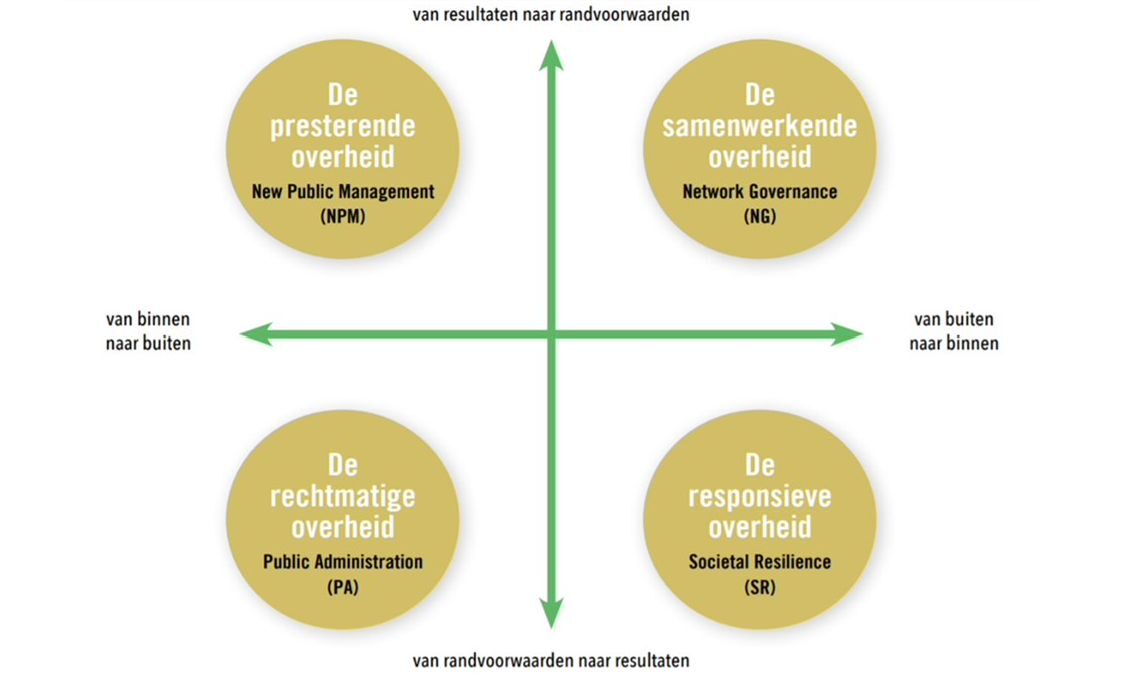
So the question is: how do we see ourselves in relation to others? And do others see us the same way?
Is the official primarily a...
- Public servant who serves the public interest (PA)
- Entrepreneur who wants to realize social value (NPM)
- Partner that connects the various interests of stakeholders in a network (NG)
- Facilitator for social initiatives from individuals and companies (SR)
Is a burger primarily a...:
- Dwellers who deserve protection from the government through laws and regulations (PA)
- Customer of the government who is entitled to high-quality public services (NPM)
- Partner of the government in a network of various stakeholders (NG)
- Free person who must be given as much independence as possible for initiatives (SR)
Although the ultimate responsibility for social initiatives in most cases lies with the government, there is a choice between more initiative and self-reliance from societal actors or more direction and enforcement from the government. The beauty (and complexity) is that the government and societal actors can move freely within this quadrant.
On the dance floor, there's also conscious experimentation with role-swapping from time to time. This can be fun and exciting. Moreover, more fluidity between roles can lead to diverse and creative dances. But whichever role you take on, it's advisable to coordinate well and explicitly signal the moment of role change.
Want to learn more about the NSOB model? Then take a look at the following publication: Van der Steen et al. (2015), Sedimentation in control