Four Conditions for Connection: Why Worthy Connection is the Foundation of Every Mindful Environmental Process
- April 14, 2026
- min reading time
- Marc Wesselink

When working on societal challenges—whether it's area development, energy transition, or infrastructure—the focus is often on interests, analyses, and solutions. We map stakeholders, conduct environmental analyses, organize meetings, and design processes. Each of these is an important tool for engaging stakeholders and arriving at an outcome supported by all parties. But the success of these processes rests on a more fundamental question: is there a dignified connection with stakeholders?
Without that dignified connection, any carefully designed process is vulnerable. In fact, without a dignified connection, participation in a change or environmental process is simply not an option for many stakeholders.
But how do you achieve worthy connections in complex societal challenges? According to Merrick Hoben of the Consensus Building Institute This lies in the four conditions of the AARC mindset. This way of thinking seamlessly aligns with the principles and insights of Mutual Gains and Strategic Environmental Management (SEM). In this blog, I will elaborate further on the why, but also on the how and what you as an environmental professional can concretely do to build that valuable connection.
Why there is no connection without dignity
Environmental management is not a technical exercise: it's about people. You can keenly analyze interests and carefully define room for solutions, but if you don't succeed in truly connecting with stakeholders, they won't open up to the process, and sooner or later, the process will get stuck.
You probably recognize this: there's deep-seated mistrust, and it manifests in outbursts of anger: ‘you say you get me, but you don't understand anything,’ ‘you don't know my grief, pain, and frustration at all,’ and ‘you never did anything about it, and now that you need us, you suddenly show up.’ These and similar expressions show that a constructive connection is far off when a stakeholder doesn't feel treated with dignity.
Therefore, simply inviting people to the table is not enough. Connection is about more than a discussion or an invitation to talk. In psychology, connection is also described as the energy between people when they:
- to feel seen and valued
- To give and receive without judgment
- draw support and strength from the relationship
This means that a dignified connection requires a conscious investment in the quality of relationships. After all, many stakeholders are only open to participating in a process with an uncertain outcome when they feel treated with dignity. When people experience that they have a valued place in the process, including decision-making, psychological safety emerges. This safety leads to openness, trust, and a willingness to take risks.
This makes dignity an overarching condition for successful environmental management, especially when dealing with complex challenges. Not every actor wants to collaborate, but sometimes collaboration is necessary for a careful process. This therefore presents an explicit task for the environmental professional: to create conditions in which dignified connection becomes possible.
In many of these processes, part of this is already performed. Dignity has roughly two dimensions:
- Intrinsic dignity: the awareness of self-worth
- Social dignity: feeling seen, heard, and respected by others
Social dignity takes precedence in environmental processes, considering participation, consultation, and dialogue. However, for a stakeholder to be able to speak up or dare to take risks in negotiations, a strong sense of intrinsic worth is necessary.
Especially since the field of environmental management is often a balancing act. Conflicts, uncertainty, and power imbalances are common and can put self-worth under pressure. To build a relationship based on connection, attention to both types of dignity is therefore a prerequisite.
AARC: A Framework for Dignified Participation
To achieve both intrinsic and socially dignified connection, Merrick Hoben developed the AARC mindset. AARC stands for an arc that provides connection. Its elements help in designing a dignified participation process and thus a careful dialogue.
Acceptance and recognition
Acknowledgement revolves around the willingness to recognize the other person for who they are, even if you disagree with them on substance. This means: listening without judgment, showing that you understand what drives someone, and making space for their perspective. Acceptance and recognition directly relate to social dignity.
Seeking acceptance and recognition prompts curiosity. Questions like: what drives this stakeholder, what concerns, values, and experiences are at play, and what is truly at stake, can help build understanding.
However, this is not about ticking off a list, but about genuine interest. When acceptance and recognition are not shown, or when they are feigned, this often leads to anger and frustration, or even apathy and withdrawal, in a stakeholder.
What helps?
Small settings, genuine empathetic conversations, a willingness to tolerate emotion, and the ability to switch between clearly wanting and understanding, and openly wanting to be receptive to the beacon and binder (see chapter 15 of my SOM Handbook) are all ways to achieve acceptance and recognition.
But what is an empathetic conversation, then? Brené Brown refers in his famous animation to Theresa Wiseman, a nursing researcher who described empathy using four characteristics:
- Perspective-takingthe ability to see the world from another's perspective (“to see the world as others see it”)
- Non-judgment— not to judge the other for what he or she feels or experiences
- Recognizing emotionrecognize and understand what emotion the other person is experiencing
- Communicating that recognition— also convey the recognition to the other person
Brown succinctly summarizes the core difference with sympathy: empathy connects (“empathy fuels connection”), while according to her, the more superficial sympathy, with statements like “Ooh, that doesn't look good... but hey, have you thought about the silver lining?” creates distance between people.
Rarely can a response make something better. Connection is what makes something better.
Brené Brown
Agency
Stakeholders must experience that they can influence the process and the outcome. Without (a sense of) agency, or agency,passivity or resistance arises. An empowered stakeholder is someone who is enabled to co-shape the process, interpret information, and influence choices.
A stakeholder who feels excluded from the process will not take responsibility for the outcome. Complaints such as: “I'm being left out,” “The real pain points are not being discussed,” and “It's already decided anyway” are signals of a lack of agency.
What helps?
- Early involvement
- Transparent information
- Timely Joint Fact Finding
- Room for problem redefinition
- Possible support to compensate for power imbalances
- Where possible, co-creation is the most powerful form of agency.
R — Reciprocity
Reciprocity, reciprocity, is about striving for a constructive balance between giving and taking. If stakeholders give something up, they must be able to trust that efforts are being made to restore the balance, in other words: that something is being gained in return. This is not purely a legal matter of compensation, but an experienced balance. The less trust there is between parties (for example, because they disagree on the facts), the more closely the balance is scrutinized. In that case, if the balance is missing, the desire to restore it becomes almost transactional. This narrows the ZOPA (Zone of Possible Agreement) and parties are quicker to fall back on their BATNA (Best Alternative to a Negotiated Agreement). The pursuit of a balance between giving and taking is therefore an important condition.
The feeling of balance is not only found in the outcome of the conversations but also in the time, energy, and perhaps money that stakeholders invest in the process. That investment also carries weight in the eyes of the stakeholders.
What helps?
- Building trust through consistent behavior
- Paying attention to a creative value creation process to arrive at ideas for more balance
- Clear rules about what is understood by reciprocity
- Balance between giving and taking throughout the entire process
C — Process Transparency (Clarity)
Clarity, transparency of the process, is about clarity: where do we stand, what are the steps, and what is expected of whom? Stakeholders seek predictability. Uncertainty about process steps, roles, or timelines leads to defensive behavior and undermines trust and agency. When this happens, you often hear complaints.
Transparency actually strengthens predictability and thus the psychological safety of stakeholders. A lack of transparency is often visible in complaints about time pressure, information overload, or unclear agendas. Therefore, to achieve sufficient clarity, there must be a clear definition of the task, concrete milestones, understandable process language, and realistic expectations regarding effort and time.
What helps?
- Simply asking stakeholders if they understand which process they are in and shaping the planning together.
- Involving stakeholders in creating a schedule, showing interdependencies, and, for example, lead times.
- Further detailing with the stakeholder how their participatory role will be given shape.
- Discussing the end of the assignment early: when is it finished, how is decision-making done, and what happens afterward?
AARC in relation to SOM
The four elements of AARC thus strengthen both intrinsic and social dignity. Acceptance, agency, and reciprocity directly contribute to the feeling of mattering. Transparency supports the feeling of knowing what is coming and being able to deal with it consciously.
Within the SOM method, this means that in the initial phases of the process, emphasis must be placed on these conditions. A dignified connection is not a byproduct, but an explicit design task within the process.
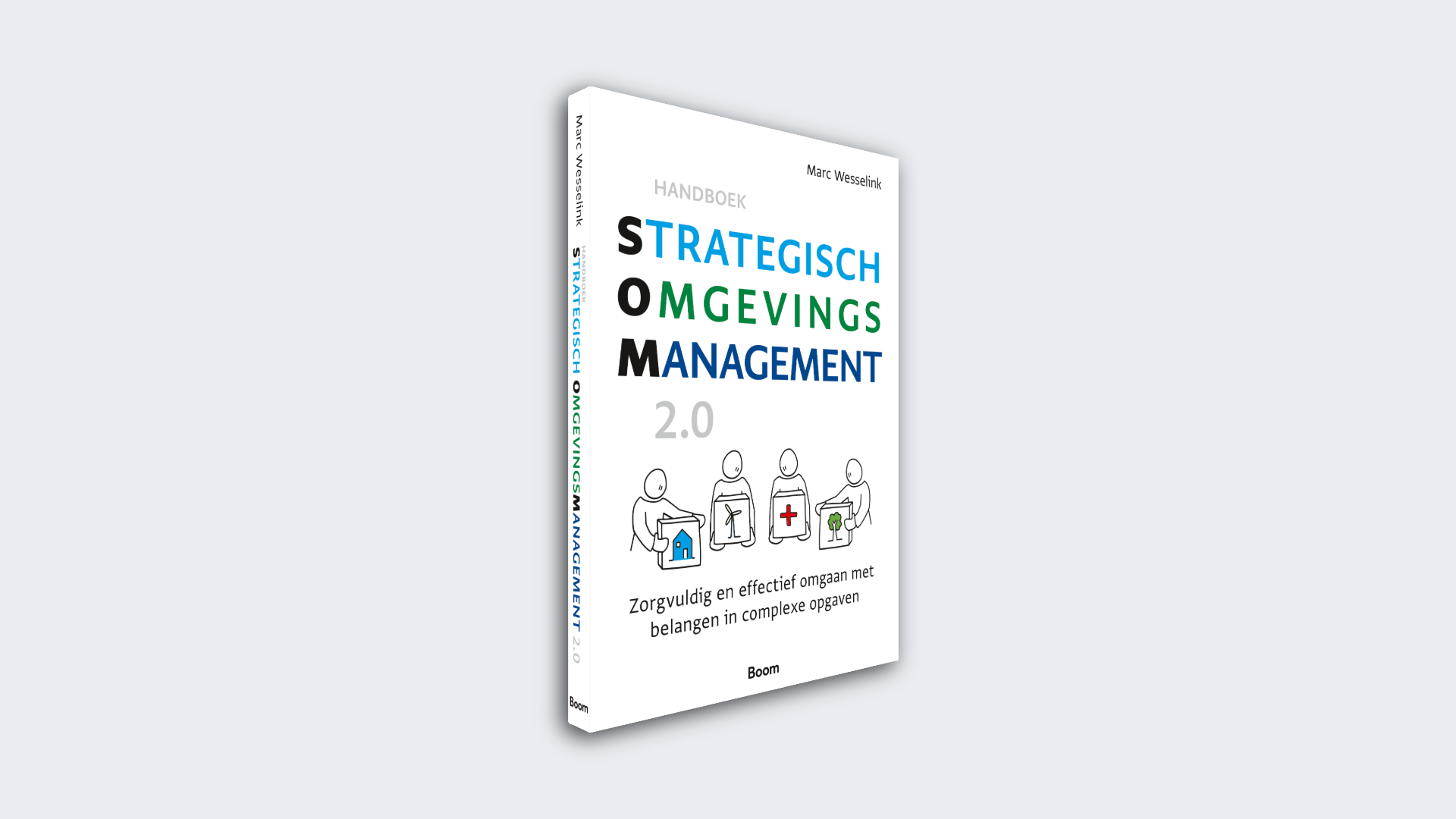
The SOM analysis helps map potential issues that affect stakeholder interests. We look not only at the issues directly related to the initial assignment but also at what is already in the ‘basket of woes.’See SOM 2.0 HandbookThis is how we proactively build relationships with topics of importance to the stakeholder and come to the table well-prepared. After all, we can show that we've made an effort to delve into the stakeholders‘ issues and interests. It often happens that the analysis reveals more issues and interests than were initially discussed with the stakeholder. If we revisit the analysis after ’the open-minded conversation‘ and review the remaining issues and interests, it often yields useful insights and a deeper connection: ’you've really taken the time to understand me." The ANNA conversations are particularly well-suited for this. A final example is helping stakeholders become empowered by, for instance, enabling them to hire their own legal or environmental advisors to support negotiations.
Finally: connection as a design task
The four conditions are not in random order. Acceptance and recognition form the starting point. Without that basis, there is little point in talking about reciprocity or process transparency.
The essence for environmental professionals is that dignified connection is not a soft prerequisite, but a core competency: personal and organizational. It requires vision (Mutual Gains), leadership, skills, and organizational anchoring.
When these four conditions are met, space is created. Space for dialogue, for collaboration, and for joint problem-solving. Only then can a societal change process truly be called careful.